


In this Vavoza Insider Plus article, I’ll share the top 5 keys to success with YouTube ads in 2026, particularly if you sell informational products, such as online courses, educational programs, coaching, memberships, consulting, and so forth.
These insights are based on our agency’s expertise and experience in managing tens of millions of dollars of ad spend and generating over $100 million in revenue for our clients.
However, in this article, my goal is not to speak to experts or those with massive budgets; rather, my goal is to help beginner advertisers get started with YouTube ads, run efficient campaigns, and avoid making costly mistakes.
Without further ado, below are the top 5 keys to success with YouTube ads in 2026!
1) Do Not Use the ‘Maximize Conversions’ Bidding Strategy
One of the biggest myths in paid advertising is that you must start with the ‘Maximize Conversions’ bidding strategy to let the algorithm learn and identify your likely cost per lead (CPL). This is a very bad approach for a beginner with an advertising budget under $10k/day.
Some advertisers teach this approach because it’s what Google recommends. Others do it because they run large-budget campaigns and, honestly, are a bit out of touch with what it’s like for a complete beginner to run paid ads.
Can I tell you a secret?
It’s actually easier to run larger campaigns than smaller ones. It’s significantly easier to work with larger clients for various reasons, which is why many agencies (including ours) require minimum monthly budgets.
So, if you’re a beginner, I would be extremely cautious about taking advice from anyone who is overly cavalier about advertising budgets, as if everyone spends thousands of dollars daily.
In reality, most individuals and businesses that run their own campaigns without the aid of agencies have relatively small budgets for paid advertising (under $300/day), and it’s crucial for them to know what I’m sharing in this article.
Advertising can get very wasteful and unprofitable when done incorrectly – and the smaller your budget, the more challenging it can be. And anyone who spends their own money on ads understands how nerve-wracking it can be to blow through thousands of dollars without getting anything in return.
If you run a large-budget campaign (say $2,000+ per day from the get-go), you can afford to have a high cost per lead (CPL) that will inevitably result from not setting a bid. For instance, in the info product space, a $30+ CPL is high – and completely unnecessary at the early stages.
Companies with large budgets prioritize generating a high volume of customers rather than maximizing return-on-ad-spend (ROAS); however, beginners with smaller budgets struggle to sustain such a campaign.
Therefore, it is foolish for experienced advertisers to recommend this approach without considering the budget constraints of beginners or smaller businesses, as leads can be generated significantly more efficiently at the early stages.
So, what should you do?
I recommend starting with the Target CPA bidding strategy and setting a bid of $8 from the get-go.
If your campaigns generate leads, great. If not, slowly increase your bids until you start gaining traction (an early sign of a sufficient-enough bid is generating impressions and clicks).

Doing so will keep your average cost per lead significantly lower than starting with the Maximize Conversions bidding strategy, and you can always increase your bids as you scale up.
Depending on your niche and sales funnel, you may or may not be able to generate clicks with an $8 Target CPA bid. However, start low and slowly increase the bid in 15% increments.
We have always taken this approach at our agency and will continue to do so in 2026 for every new campaign we launch for clients. This is how we maximize performance at early stages and then quickly scale our clients’ campaigns while keeping the CPL reasonable.
- Meanwhile, other agencies start with a $40+ CPL and have to educate clients on a so-called “90-day learning phase” where the campaigns “are not expected to perform well,” which, by the way, is also a myth propagated by advertisers who are not otherwise aware.
For your reference, in most niches in the info product space targeting the US market, you can realistically spend $2,000/day at a cost of less than $20 per lead – often as low as $13 per lead at the early stages. Meaning, at a Target CPA bid of less than $20.
We only start using the Maximize Conversion bidding strategy when scaling a well-performing campaign (nearing $10k/day in spend) or when retargeting a warm audience pool, typically for direct purchases.

2) Test Fewer Creatives
Another myth is that “you should constantly test many creatives.” This approach is propagated by individuals who excel at Facebook ads but lack experience in YouTube ads (or simply don’t yet know what I’m about to explain).
The truth is, you do NOT want to test too many creatives/ads with YouTube ads because if you’re constantly testing new videos, your performance will be unstable, unpredictable, and inefficient in producing ROAS and revenue.
And that’s the key factor: continually testing new videos can boost lead volume, but often at the expense of ROAS.
I recommend starting with 5 videos per ad group and testing a new video once a month. You can replace the lowest-performing video in the existing campaigns or start a new campaign with the new video, and then eventually feed it into your primary campaigns (if it performs well).
Give Google’s algorithm sufficient time to test and self-optimize the targeting for each video you run. The lower your budget, the more time is needed. If your spend is under $1,000/day, give it at least 14-21 days before assessing the performance.
By the way, split-testing (also known as A/B testing) of any kind is inconsequential for small-budget campaigns and can even have a negative impact on performance. It’s best suited for large-budget campaigns, where you can observe an incremental yet statistically significant difference, which is typically not the case at a smaller scale.
3) Don’t Spread Your Budget Too Thin
Recently, I consulted an individual who started running YouTube ads for their new VSL funnel.
His concern was that the cost to acquire a $97 buyer was over $1,000, so he shut off the campaign that had produced the initial sale and launched a new one.
However, after reviewing his campaigns, I quickly realized that he was spreading his budget too thin across various campaigns, ad groups, demographics, geographic locations, and so forth.
And we determined that it actually only cost him around $400 to acquire that buyer (which is a reasonable start). Of course, one buyer is statistically insignificant, but my point stands:
Ensure you are not spreading your budget too thin across various targeting.
Start with three different campaigns, each with one ad group and one unique audience. Then, as soon as one of your campaigns produces a few sales, shut off the other two campaigns.
This requires a bit of a gut check to ensure the campaign you’re keeping is capable of producing more sales, but the idea is to allow the algorithm to learn as narrowly as possible while allocating your full budget to the audience that shows early signs of performance.
This way, you can keep your spending to a minimum while allowing Google to learn to acquire more buyers.
You can take it a step further and narrow down your demographic and location targeting to what produced your first tracked sales.
And remember, if your budget is low, be patient. You want the campaign to run uninterrupted for a couple of weeks (while ensuring you don’t spread your budget too thin, hence only one campaign, one ad group, and one audience).

4) Use A Custom Conversion Goal
This is absolutely non-negotiable. If you want to generate buyers as efficiently as possible, you must tell Google’s algorithm what conversion to optimize for (while keeping your CPL reasonable with your Target CPA bids).
You do this by creating a custom conversion and placing a pixel on your post-purchase confirmation page to attribute anyone who visits it to the custom conversion.
Add your custom conversion to Conversion goals in the campaign settings.
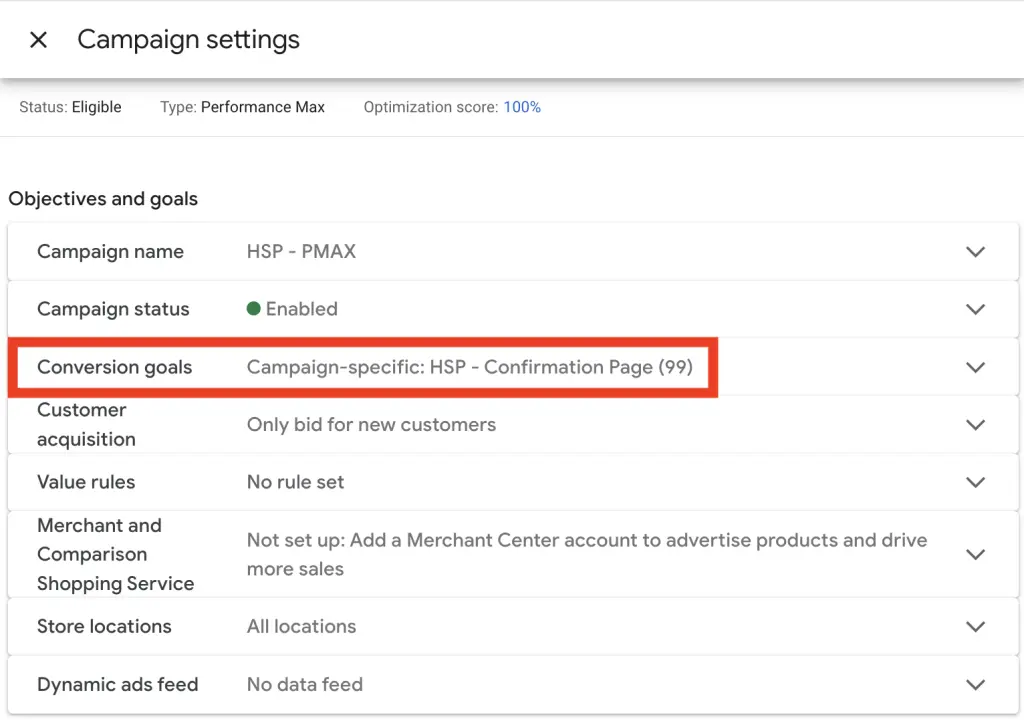
The reason for doing so is not only to ensure Google’s algorithm optimizes for people who are likely to land on your post-purchase confirmation page (after completing a purchase), but also to prevent it from optimizing for bot leads.
Bot traffic can drain your budget, so ensure you optimize for an action that only a real human can take, such as completing a purchase.
If you cannot place a tracking pixel on the post-purchase confirmation page, consider tracking a different action in your sales funnel (e.g., when someone attends your webinar room).
However, at the early stages of your campaign, don’t assign more than 2 custom conversions to any individual campaign. Optimize for the initial lead conversion and the initial purchase only.
Do not optimize for every conversion in your sales funnel, or Google will prematurely require you to increase your Target CPA bids to generate sufficient volume.
5) Demand Gen and Performance Max
This tip is for those who promote low-ticket paid funnels, also known as self-liquidating offers (SLOs) or tripwire offers.
If the first conversion action in your sales funnel is a low-ticket purchase (e.g., a paid webinar registration), you should definitely run a Performance Max (PMAX) campaign, because it absolutely crushes every other type of campaign.
However, only do so after running regular video ad campaigns (via Demand Gen) so that you can use your best audiences in PMAX targeting.
As you scale up, you may be pleasantly surprised by how efficient and effective PMAX can be compared to Demand Gen in terms of generating a high volume of buyers at a relatively good ROAS.
Can I Confess Something?
There is way more I would like to share with you about successfully running YouTube ads, but explaining everything would require converting this article into a book!
That is precisely why I created a step-by-step video course that shows you how to prepare, launch, optimize, and scale YouTube ad campaigns in great detail, following our agency’s unique process.
It’s called YouTube Ads Pro, and it’s available exclusively to Vavoza VIP members.
If you found value in this article, consider joining Vavoza VIP to gain access to YouTube Ads Pro and other valuable resources from our agency.
I’ll teach you our proprietary advertising method so that you can run highly profitable and successful YouTube ad campaigns – starting from scratch.
Become a Vavoza VIP member and get access to YouTube Ads Pro – click here
– Vlad
