


ai.com announced on February 6, 2026, that it is launching autonomous AI agents for consumers, with the product set to officially debut on February 8 following a Super Bowl LX commercial.
The platform was founded by Kris Marszalek, who also serves as CEO of Crypto.com.
The new offering allowed users to create private, personal AI agents designed to carry out tasks on their behalf, rather than only responding to prompts.
According to the company, agents could organize work, send messages, execute actions across applications, and build projects.
The agents were also designed to autonomously develop missing capabilities required to complete tasks, with improvements shared across the broader ai.com network.
ai.com said each agent operated in a dedicated, encrypted environment with user-specific permissions and controls.
Users could deploy agents for activities such as workflow automation, calendar management, and other digital tasks, with future support planned for financial and marketplace integrations.
The company said the product was designed for consumers without technical expertise, enabling users to create an agent within minutes through their ai.com profile. A free tier will be available, alongside paid subscription options.
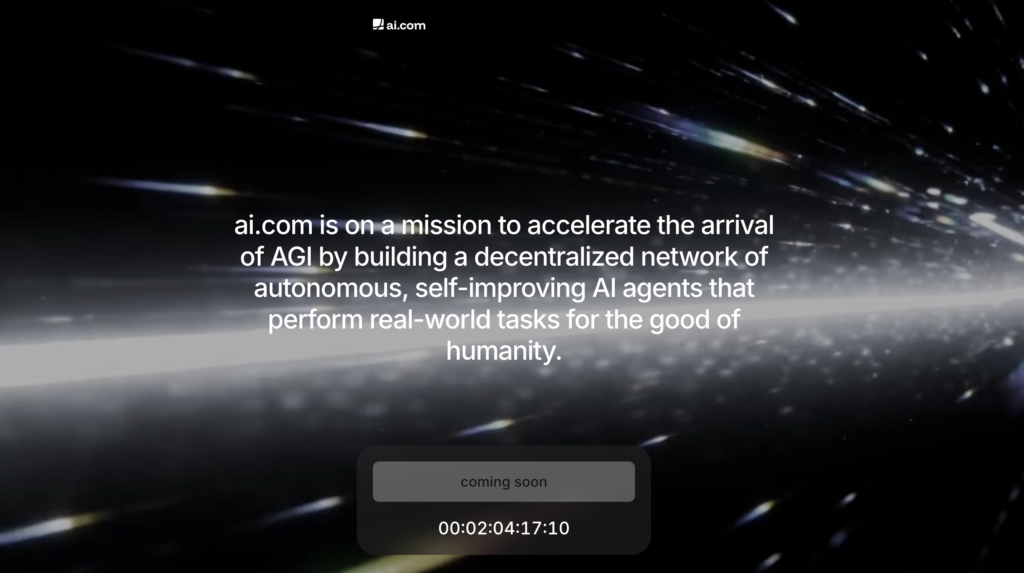
Image Credit: ai.com
Why This Matters Today
AI agents have largely remained tools for developers and enterprises due to infrastructure complexity and technical requirements.
ai.com’s launch targeted a broader consumer audience by packaging agent-based automation into a simplified, permission-based product.
The announcement reflected a shift in how AI platforms framed value.
Rather than focusing on chat interfaces, ai.com positioned agents as autonomous actors capable of executing tasks across digital services. If widely adopted, this approach could change how individuals manage routine work and personal digital workflows.
The planned Super Bowl debut highlighted a push toward mainstream visibility. High-profile launches have historically accelerated adoption for consumer technology platforms by introducing new concepts to non-technical audiences.
The model also raised questions around governance and trust. Autonomous agents operating across apps and services required strong safeguards around permissions, data security, and error handling. ai.com said agents remained constrained by user-defined limits and operated in isolated environments.
As competition in agentic AI increased, success will depend on reliability, interoperability with third-party services, and whether consumers find sustained value beyond early experimentation.
Our Key Takeaways:
ai.com introduced autonomous AI agents aimed at everyday consumers. The product emphasized task execution rather than conversational assistance.
A high-profile launch signaled a push toward mainstream adoption. Long-term impact will depend on trust, usability, and real-world performance.
- ai.com announced autonomous AI agents ahead of a public launch on February 8, 2026.
- The agents were designed to execute tasks across apps while remaining permission-based and private.
- Consumer adoption will test whether agentic AI can move beyond technical users into daily use.
You may also want to check out some of our other tech news updates.
Wanna know what’s trending online every day? Subscribe to Vavoza Insider to access the latest business and marketing insights, news, and trends daily with unmatched speed and conciseness. 🗞️