


People don’t buy the product; they buy the feeling the product evokes. Some of the most successful advertising campaigns are based on connecting with customers emotionally.
Now, emotional marketing is a vast topic. Depending on which approach you take with it, it can motivate your customers to purchase through various feelings: inspiration, anger, despair, happiness, and more.
Today, we’ll discuss Optimistic Advertising – a marketing strategy that builds a connection with the audience and customers through positive feelings, such as happiness, comfort, hope, and motivation.
The main objective of optimistic advertising is to frame your brand’s message in a positive light. Your ads should focus on anything positive your product can bring to someone’s life – solutions, personal growth, and the feeling of accomplishment.
Optimistic advertising consists of 3 key elements: verbiage, visuals, and psychology.
Verbiage and Messaging Style
The first key element is the language and wording used in an ad, as well as the kind of message you’re trying to relay. Your choices of words can evoke different emotions, but the common denominator for those emotions should be positivity. Here are some examples:
- Empowering and Motivational: After reading your ad, your customers should feel motivated and empowered to improve their lives. They should believe in two key things: their potential and that not having your product is the only thing stopping them from fulfilling it. Think of Nike’s “So Win” campaign, which inspires Nike’s customers to push their limits.
- Light, Easy-going, and Humorous: Use humor and storytelling to create an entertaining and joyful ad experience for your audience. The Coors Light “Groomsmen” commercial is a great example. It’s short, light, wordless, and uses just enough storytelling to create a feeling of relief and joy at the end.
- Comforting and Reassuring: Insurance companies typically use this approach. Their ads are worded to give the audience a feeling of safety, help, reassurance, and security. Think of the New York Life “Always Protected” commercial. The ad reassures the viewers that they made the right choice for themselves and their families when they decided to sign up for the NYL’s financial services.
- Nostalgic and Heartwarming: Ads that evoke feelings of long-forgotten positive memories, warmth, and connection. The Farmer’s Dog relayed these feelings to its audience perfectly with its “Forever” commercial.
Visuals
The visual elements you use for the optimistic ad campaigns play a vital role in the campaign’s success. Here are some visual elements that will accentuate the positivity:
- Vibrant, Bright, and Warm Colors: Cheerful colors like yellow, orange, pink, and sky blue naturally bring out the feelings of happiness and optimism.

- Smiling People and Cute Pets: Positive ads typically feature people enjoying themselves, playing with pets, seeing fitness results in the mirror, or having fun with family and friends. These scenes are pleasant to the eye and create a deeper connection with the audience.

- Uplifting Scenery: Beautiful landscapes, such as beaches and fields, serene environments, and sunshine, add an aspirational feel to the ad.

Psychology
Wouldn’t you agree that believing in something good that may happen is much easier than accepting negativity? It’s one of the main principles of positive advertising.
- The Hope Theory: A positive psychology framework that involves pathway thinking, goal setting, and agency. Nike’s “One Day We Won’t Need This Day” campaign emphasized unity and gender equality and gave women (not just athletes) hope for a better future.
- Belief in Self: Optimistic ads work by tapping into the consumer’s belief in their ability to reach their goals. Such advertising often showcases relatable individuals succeeding, boosting the consumers’ belief in themselves. “Believe In Yourself” by Gatorade represents this feeling.
- Emotional Contagion: Humans are naturally prone to catching the vibe of others. Seeing others happy and smiling automatically boosts our mood, too, even if it’s in a commercial. This creates a positive association with your brand. The Coca-Cola “Coke Hug Machine” is a great example of that.
Why Is Optimistic Advertising Trending?
There are several reasons why optimistic advertising is trending today:
Emotions Drive Results: Product-first advertising doesn’t work for everyone, but putting your customers’ emotions and feelings first will always deliver results. Making your customer feel something positive drastically increases brand favorability and the desire to purchase, and promotes brand loyalty. Ads that evoke happiness have higher sharability and engagement.
There Is Too Much Negativity: Work stress, relationship problems, bills, politics, and worldwide crisis dilemmas increasingly affect people’s mental health. Many people are emotionally exhausted and crave to see some sort of light at the end of the tunnel. Positive, uplifting, and inspiring ads can be a piece of that light for your audience.
Newer Generations Value Positivity: Gen Z and Millennials are key players in today’s economy, and they take their mental health seriously, actively prioritizing and promoting mental wellness. Campaigns that promote happiness and hope for a better world deeply resonate with these generations.
Storytelling Is Better Than Pushy Sales: Stories make people feel things and relate to your content, which makes them more likely to remember your brand and make a purchase.
Examples of Optimistic Advertisement Campaigns
Here are some popular optimistic ads for your reference:
- Budweiser Lost Puppy SuperBowl Commercial
- Porsche 911 Sport Classic
- Nike – Stairs
- Thai Life Insurance – Believe In Good
- Whiskas – Kitten Dreams
- Nike – So Win
- Starbucks – Every Table Has A Story
- Nike – What If You Can
- Freshpet – Dinner Date Commercial
- Adidas – We All Need Someone To Make Us Believe
- Porsche – A Drive Like No Other
- New York Life – Always Protected
- Coors Light – Groomsmen
- The Farmer’s Dog – Forever

How To Create Your Optimistic Ad Step-By-Step
Step 1: The Pain Point
Identify a real struggle your target audience is facing. Maybe they feel undervalued, overwhelmed, stuck, lost hope, or left out. This step is important because optimism only works when it overpowers a different, opposite emotion – negativity.
For a visual ad or commercial, feature a character struggling with something, but don’t accentuate this scene. It is only there to assist you with telling the story – nothing more.
For this scene, choose a realistic and relatable setting, such as a park, a home, or a workplace. Natural lighting is your friend for this part of your commercial.
Step 2: A Sense Of Hope
Show how your product or service helps solve your customers’ issues. Some common “hope results” are community, transformation, a better life, a happier pet, more free time, and less stress.
Instead of focusing on the person’s problem, shift your focus to how your business is about to help them and how good they’ll feel after.
When filming this scene, focus on capturing genuine emotion and vulnerability. Try to capture smiles, laughter, happy moments with family, cozy moments with pets, and excitement. Body language can tell a much deeper story than words.
Some good clips to include would be a breath of relief, something that represents happy parenthood, a healthy and active pet, a calm mind, etc.
Step 3: Optimism Through Senses
Your ad should involve not only characters and scenes, but also strategically placed and paced elements such as colors, music, and visuals.
Colors should revolve around bright tones, natural light, or warm pastels.
Music should have at least one of the following: an upbeat tempo, acoustic instruments, uplifting instrumentals, and major keys.
Pacing applies to the entire ad. Ensure that the pace of the ad makes sense and focus mainly on the positivity. It should have a smooth flow with an emotional rise.
Visuals (like smiling faces, sunshine, scenic views, and movement) should be placed according to your creative flow.
The primary senses in ads are hearing and vision – ensure your creative promotes positivity through both.
Step 4: Verbiage For Scripts and/or Text Overlays
Some ads don’t require anything to be said – the visuals and sound effects are enough. But some ads do require scripts and typed-up text. For these, use a conversational tone and uplifting and hopeful phrases like:
- “Imagine when…”
- “Imagine if…”
- “You’ve got this!”
- “Small steps every day…”
- “Look how far you’ve come…”
- “The new version of you …”
When filming, use smooth zooms for inspiration, close-ups to show intimacy and connection, and wider shots to showcase variety, freedom, and accomplishment.
Step 5: Victory, More Hope, or Inspiration + CTA
End your ad with a simple and meaningful message and a CTA. The ending can be 2 in 1 (a CTA within a message or vice versa).
Film another clip that represents happiness, relief, hope, and inspiration, and accentuate that even more. Use similar taglines as in step 4, and add a CTA into them, for example, “The new version of you starts with {your product or service}”.
You can also let the viewers know that they’re not alone in their journey and that you (or your brand) will hold their hand throughout.
Whether your ad used verbals and text overlays or not, end it with your logo and your motto (if you have one).
Combine all of your clips together, ensuring they have a good flow with all of the elements, from the scenario and characters to colorful elements and music.
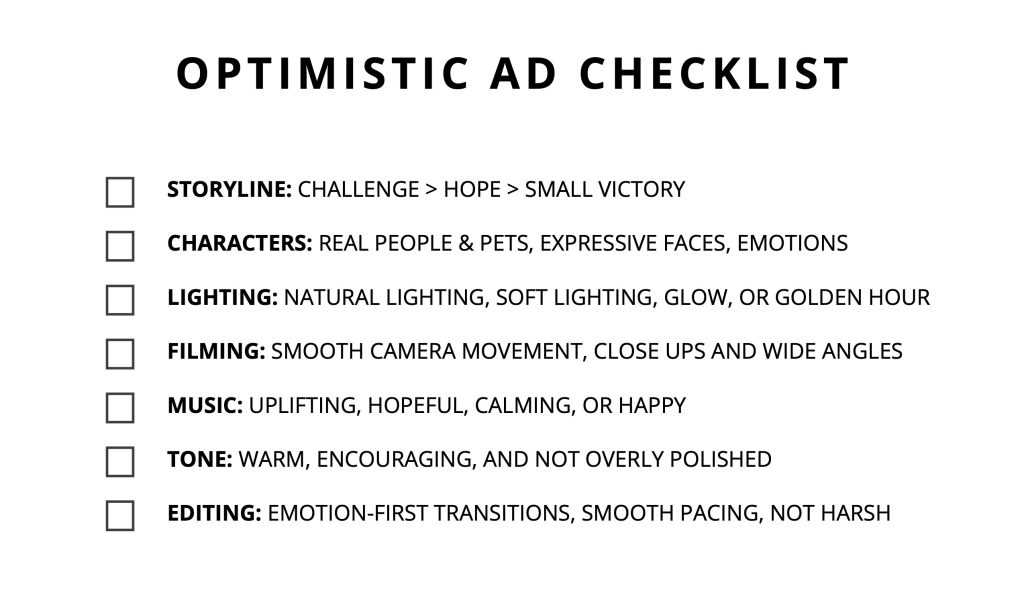
Tip: Here is a simple checklist for creating an optimistic ad to help keep you on track (feel free to right-click on it and download it).
Optimistic advertising is an impactful way to connect with your audience through storytelling, hope, and emotional uplift.
There is plenty of negativity in the world as it is. Today, choose to lead with optimism and spread positive vibes. Follow the step-by-step guide shared in this article and launch your optimistic campaign today!
Want more actionable tips continually? Subscribe to Vavoza Insider to access the latest business and marketing insights, news, and trends daily with unmatched speed and conciseness. 🗞️
Key Contributors: Stephanie Hill, Vlad Strizheus