


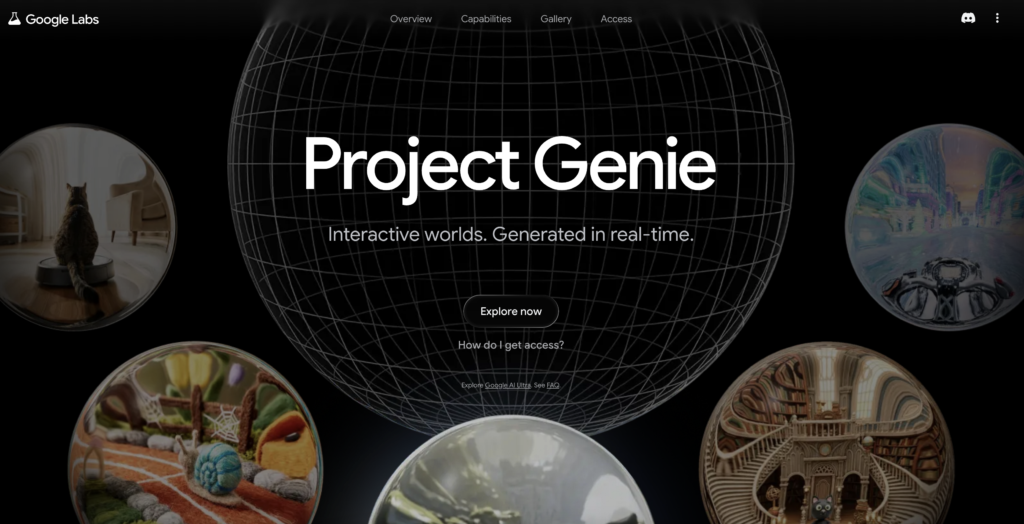
Google DeepMind announced Project Genie on January 29, an experimental research prototype that allows users to create, explore, and remix interactive worlds generated by AI.
Project Genie is powered by Genie 3, a general-purpose world model designed to simulate dynamic environments in real time.
Unlike static 3D scenes, Genie 3 generates the world as users move through it, predicting how environments evolve and how actions affect outcomes.
Google said the model can simulate physics and interactions across a wide range of scenarios, from fictional settings to real-world locations.
Access to Project Genie began rolling out to Google AI Ultra subscribers in the U.S. aged 18 and older.
The prototype is delivered as a web app and integrates Genie 3 with other Google models, including Gemini and Nano Banana Pro.
Users can create worlds using text prompts and images, navigate environments as they expand in real time, and remix existing worlds into new variations. Google said users can also download videos of their explorations.
The company described Project Genie as an early-stage prototype intended to gather feedback and study how people interact with world models.
Why This Matters Today
Project Genie highlighted Google’s progress toward building general-purpose world models, a capability considered important for advanced AI systems.
While earlier AI agents were trained for specific environments such as games, world models aim to simulate the broader complexity of real-world dynamics.
By releasing an interactive prototype, Google shifted this research from closed testing into limited public experimentation.
Allowing users to create and navigate worlds provides insight into how such models could be used beyond research, including in creative media, simulation, robotics, and training environments.
The launch also reflected growing interest in generative experiences that move beyond text and images.
Interactive worlds require consistent memory, physics simulation, and real-time generation, all of which remain challenging problems in AI development.
Google emphasized that Project Genie is experimental and includes limitations, such as short generation lengths and imperfect adherence to prompts.
These constraints underscore that world models are still in early development. However, giving users hands-on access suggests Google is preparing for broader applications of this technology as models mature and capabilities expand.
Our Key Takeaways:
Google introduced Project Genie as an experimental platform for exploring AI-generated worlds.
The prototype turns world modeling research into an interactive user experience.
It demonstrates how AI systems can simulate environments in real time rather than generate static scenes. Project Genie offers an early look at how world models may shape future AI applications.
- Google launched Project Genie, an interactive prototype powered by the Genie 3 world model.
- The tool lets users create, explore, and remix dynamic AI-generated environments in real time.
- Project Genie signals growing focus on world models as a foundation for advanced AI systems.
You may also want to check out some of our other tech news updates.
Wanna know what’s trending online every day? Subscribe to Vavoza Insider to access the latest business and marketing insights, news, and trends daily with unmatched speed and conciseness. 🗞️