


AI language models such as ChatGPT, Gemini, and Perplexity often favor well-known brands in their responses.
Emerging businesses face challenges in gaining visibility amid this bias toward familiarity.
No Fluff’s latest guide on AI visibility details five practical ways for new companies to appear in AI outputs.
These include optimizing content for conversational queries, building topical authority through in-depth resources, and leveraging structured data to enhance discoverability.
Additional strategies focus on earning high-quality backlinks from reputable sources and engaging in community discussions to signal relevance.
By implementing these tactics, smaller players can compete effectively in the AI-driven search landscape.
Below is our take on the 5 steps you should take to gain a competitive advantage in 2026.
5 Steps To Make Your Business Visible In ChatGPT, Gemini, and Perplexity
Here’s the thing: When someone asks ChatGPT, “What’s the best online course platform?” or “Which business coach should I hire?”, your name probably doesn’t come up.
Not because your product isn’t good. Not because you’re too new (at least in the algorithms’ mighty eyes).
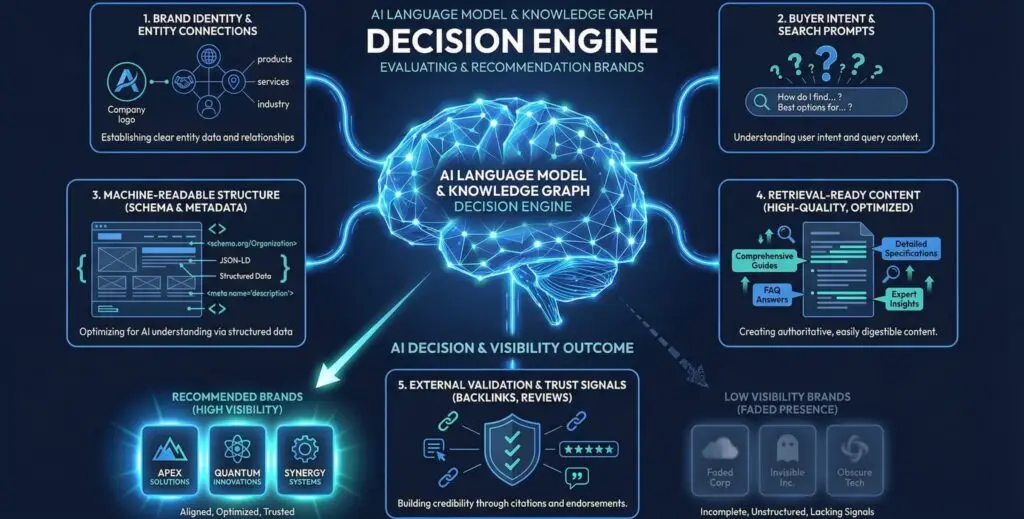
It’s because AI systems don’t evaluate you the way Google does. They don’t rank pages. They evaluate entities. They look for brands that are easy to verify, cross-reference, and recommend safely.
If your digital footprint is thin or inconsistent, AI will replace you with a competitor it trusts more – it’s as simple as that.
Here’s what you should do about it:
Step 1: Map Your Brand Entity
Before you touch your website, you need to define your brand in a way that machines can understand.
ChatGPT and Gemini don’t read your sales page the way a human does.
They connect facts, names, and relationships into what’s called an entity. If those connections are missing, your brand won’t appear. Period.
Here’s how to do it:
Define your business using semantic triples.
That means structuring your information in a [Subject] → [Predicate] → [Object] format. For example: “Sarah Chen” → “teaches” → “Facebook Ads for Course Creators.”
This gives AI a clear, machine-readable fact to work with.
Use public, widely understood language.
If you describe your coaching program using internal jargon that doesn’t match how the category is commonly defined, you risk being misclassified.
Pull terminology from sources like Wikipedia. If the industry calls it “online course,” don’t call it “digital learning experience” on your site.
State your authority clearly. Write 3 to 5 simple, factual claims you want AI to associate with your brand. “Helped 2,000+ entrepreneurs launch profitable coaching businesses” is specific.
“We help people succeed” is not.
Also, define your competitive position. What specific niche do you own? What audience, problem, or angle sets you apart? If you teach email marketing for health coaches, say exactly that.
The narrower your positioning, the easier it is for AI to match you to the right prompts.
Step 2: Build Your Benchmark Prompt Set
You can’t improve what you can’t measure. And you can’t rely on traditional SEO tools to track AI visibility. Most of those tools use inferred data rather than real prompts.
Here’s what to do instead:
Reverse-engineer buyer questions. Think about what your ideal customer would type into ChatGPT. Not keywords. Full questions.
Things like “Who’s the best Facebook Ads coach for course creators?” or “How do I scale my online coaching business past $10K/month?”
Use keyword research tools, People Also Ask results, and ask multiple AI engines yourself.
Create a fixed set of 150 buyer-authentic questions.
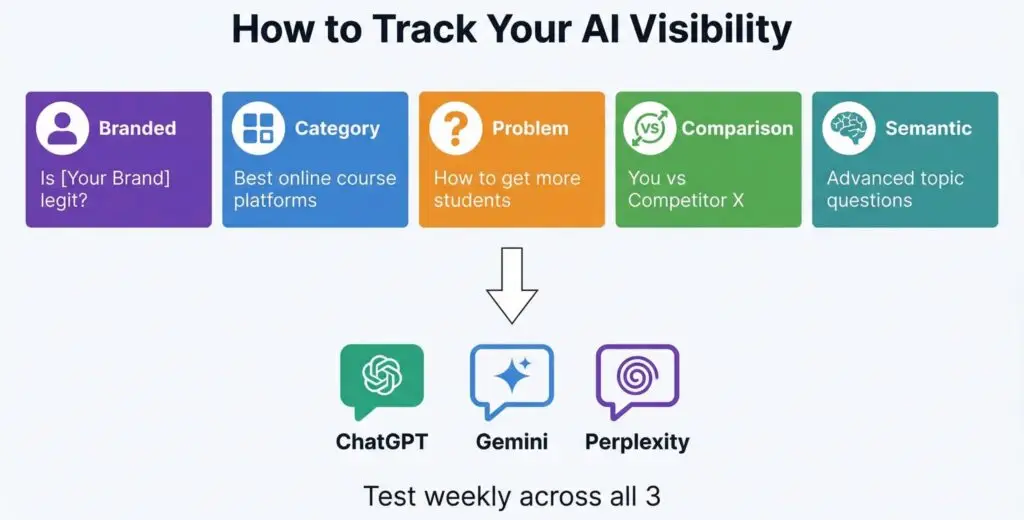
Organize them into clusters: Branded (your name), Category (your industry), Problem (pain points you solve), Comparison (you vs. competitors), and Advanced Semantic (deeper topic questions).
Run these prompts weekly. Test them across ChatGPT, Gemini, and Perplexity.
Track when you show up, when competitors show up, and when no relevant parties show up (those are your biggest opportunities).
For info product sellers, this is gold. Most of your competitors are not doing this at all.
The ones who start tracking their AI visibility now will have a massive head start.
Step 3: Make Your Site Machine-Readable
AI systems don’t care about your beautiful sales page design. They care about how easily they can parse your data.
According to the experiment tracked by Search Engine Journal, the first page was picked up by AI on day 27.
And the sites that got picked up fastest weren’t the ones with the most content.
They were the ones with the cleanest technical structure.
Here’s what that looks like:
Implement JSON-LD Schema Use Organization, Service, Person, and FAQ schemas to tell AI exactly who you are and what you offer.
If you’re a coach, use a Person schema tied to your Organization schema.
This connects your identity to your business in a way machines understand.
Deploy an llms.txt file. Place this at your domain root. It’s a plain-text guide for AI crawlers that tells them how to describe your company and which pages to prioritize.
If you’re running your coaching or course business on platforms like Kajabi, Teachable, or WordPress, check whether your platform supports custom schema markup and llms.txt files.
If it doesn’t, you may need a workaround or a custom landing page.
Step 4: Publish “Retrieval-Ready” Content
This is where most course creators and coaches go wrong. They write long-form content designed for humans browsing their blog.
But AI doesn’t browse. It extracts.
According to the patterns observed in the 12-week experiment, content that wandered (even if it was thoughtful) consistently lagged in AI pickup.
The pages that got cited were tighter, more structured, and answered the question up front.
Here’s how to write content that AI actually picks up:
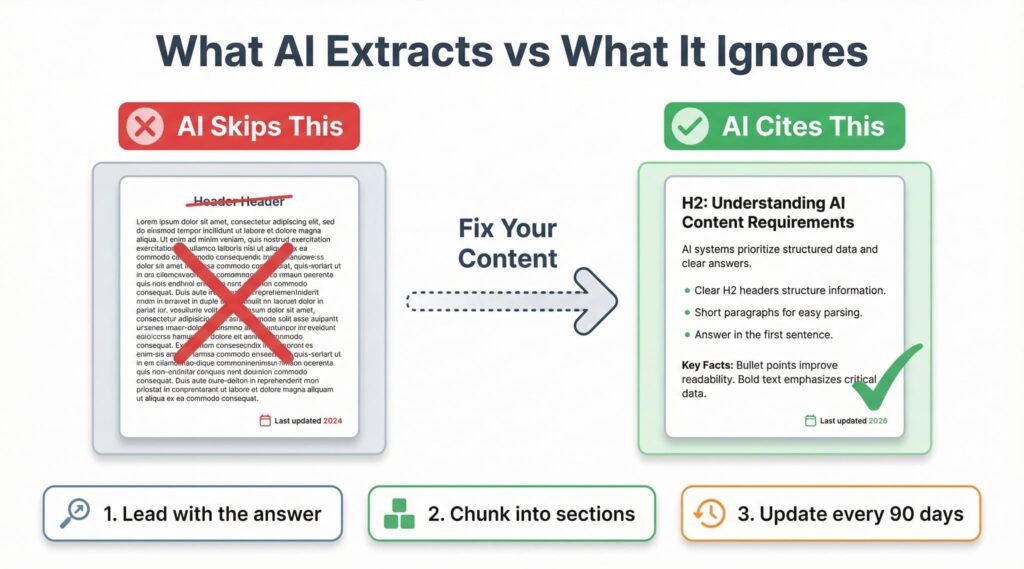
Lead with the answer. Start every section with a direct, factual answer to the question it addresses. Don’t build up to it. AI extracts the first clear statement it finds.
Chunk your content semantically. Break your articles into logical, independent sections that can be pulled out and reused without needing the full page for context.
Each H2 or H3 headline should be able to stand on its own.
Keep content fresh. If you published a guide six months ago and haven’t touched it, AI systems may stop referencing it.
Set a quarterly refresh schedule for your most important pages.
Publish on high-authority platforms first. The experiment found that in the first two weeks, most AI citations came from LinkedIn and Medium posts, not the brand’s own website.
If you’re just starting, post your best ideas on LinkedIn.
For course creators and coaches, this means your “pillar content” (the stuff that defines your expertise) should be structured like a reference guide, not a blog post.
Clear headers. Direct answers. Updated regularly.
Step 5: Earn External Validation
This is the step most people skip. And it’s the one that matters most.
AI systems cross-check what your site says against the rest of the web. If nobody else is saying what you’re saying, AI treats your claims as unverified.
The experiment confirmed this: even with strong content and good structure, brands struggled to get recommended without outside validation.
Here’s how to build that external trust:
Claim your directory profiles. Get listed on Crunchbase, G2, and any industry-specific directories.
Make sure your business name, description, and positioning are consistent across all of them. Inconsistencies across profiles are a primary cause of AI hallucinations about your brand.
Get mentioned in authoritative publications. Guest posts on industry sites, podcast appearances, and features in niche media all count.
The key is targeting publications that AI already trusts and cites.
One mention in Forbes or Entrepreneur will do more for your AI visibility than 50 backlinks from random blogs.
Build intentional external links. For every important page on your site, aim for at least three external link-backs from authoritative sources. This is what triggers AI pickup. Not volume. Quality and relevance.
For coaches and course creators, the fastest path here is podcast guesting.
Podcast show notes create backlinks, transcripts create citable content, and the host’s existing authority transfers to you. It’s one action that checks multiple boxes.
Why It Matters Today?
As AI tools become primary information sources, visibility in their responses directly influences lead generation for online entrepreneurs.
Emerging businesses that adapt these strategies can capture more audience attention without massive marketing budgets.
For course sellers, prioritizing conversational content aligns with how users interact with AI, potentially boosting engagement rates.
Automation workflows can incorporate these optimizations to streamline content creation and distribution efforts.
This shift challenges traditional SEO, urging coaches and course creators to rethink funnel optimization around AI preferences. Staying ahead ensures sustained growth in a rapidly evolving digital ecosystem.
Our Key Takeaways:
These strategies offer actionable steps for new businesses to navigate AI biases and secure prominent placements in model outputs.
- AI defaults to familiar brands, but optimizing for conversational search helps emerging companies break through.
- Building authority through quality content and backlinks enhances long-term visibility and lead flow.
- Watch for evolving AI algorithms that may prioritize structured data and user engagement signals.
Would you like to keep up with the latest digital marketing trends and tech news daily with unmatched speed and conciseness? Subscribe to Vavoza Insider 🗞️