

Most creators post YouTube Shorts and hope the algorithm picks them up.
But hope is not a strategy, and the algorithm is not random.
YouTube Shorts now generates over 200 billion daily views and has surpassed 2 billion monthly active users – making it one of the largest short-form video platforms on the planet.
The United States alone accounts for 175.1 million users, with the largest demographic being adults aged 25 to 34.
More importantly, YouTube just rolled out a dedicated Shorts search filter in early 2026, allowing users to search specifically for Shorts when they need a quick answer, a fast tutorial, or a rapid demonstration.
This is a fundamental shift. Shorts are no longer just a feed-based discovery tool – they are now a searchable content format competing directly in YouTube and Google search results.
If your Shorts are not optimized for search, you are invisible to viewers actively looking for exactly what you teach in your course or coaching program.
This guide breaks down how the YouTube Shorts algorithm works in 2026, what signals it rewards, and how to rank your Shorts in front of the right audience.
How The YouTube Shorts Algorithm Works In 2026
The Shorts algorithm operates as a separate system from the one that ranks long-form YouTube videos.
It’s built around viewer behavior, not just metadata, and it uses a rapid testing model to determine which videos deserve wider distribution.
When you upload a Short, YouTube immediately begins running what it calls an “explore-exploit” test, according to Social Champ. It shows your video to a small sample of users and measures how they respond.
The algorithm tracks:
- Viewed vs. Swiped Away: The most critical signal. If viewers stop and watch instead of swiping past, the algorithm interprets this as a strong engagement signal and expands distribution.
- Audience Retention and Completion Rate: YouTube measures what percentage of your Short viewers actually watch to the end. Shorts that are rewatched perform especially well because replays signal high satisfaction.
- Viewer Interaction: Comments, likes, shares, and remixes all tell the algorithm your content is resonating. The more interaction a Short receives in its first few hours, the more aggressively YouTube pushes it to new audiences.
- Watch History and Topic Relevance: The algorithm matches your content to users who have previously watched similar topics. This is why niche consistency matters – channels with a clear subject matter provide stronger context signals, improving how Shorts surface in discovery feeds.
Beyond engagement, YouTube’s AI now analyzes the video itself.
In 2026, Google’s multimodal language models process the spoken audio, on-screen text, and visual environments within each Short.
This means your video can surface in relevant searches even with minimal metadata – but optimized metadata still gives you a significant edge.
The bottom line: the algorithm does not care what your video is about until it knows people are watching it. And it will not keep showing your video unless they stick around.

How To Rank YouTube Shorts In 2026: Step-By-Step SEO Guide
Here is a step-by-step guide for course creators, coaches, and info marketers on how to make YouTube Shorts show up in search results for the right audience:
Step 1: Identify “Quick Fix” Keywords Your Audience Is Searching
The Shorts search filter changed the nature of Shorts SEO. Viewers who use the filter are typically looking for fast answers, not long tutorials. Your keyword strategy should match this intent.
Use tools like VidIQ or TubeBuddy to find search terms with clear “quick fix” or “how to” intent in your niche.
You can also type your topic into the YouTube search bar and pay attention to the autocomplete suggestions – these are real queries your audience is typing.
Focus on long-tail keywords that are specific enough to have low competition but high enough intent to attract buyers.
- For example, instead of targeting “email marketing,” go after “how to write a subject line that gets opened.” The more specific the query, the more likely the viewer is ready to take action.
Prioritize questions your audience asks repeatedly in comments, DMs, or discovery calls. Those are the exact search queries you should be ranking for.
Step 2: Craft a Keyword-Rich Title That Mirrors Real Search Queries
Your title is the most important piece of metadata for Shorts SEO. YouTube’s systems and users see it immediately, making it your first and most critical shot at relevance.
Write titles that sound like something a person would actually type into a search bar. “How to frost a cake in 30 seconds” outperforms “Cake Goals” every time.
The goal is to match search intent, not just grab attention.
Here are the rules for a high-ranking Shorts title:
- Include your primary keyword in the first few words of the title.
- Keep the total length to 40-50 characters so it displays fully on mobile devices.
- Use natural language – avoid jargon, internal product names, or clever wordplay that only makes sense after watching.
- Frame it as a question or a direct solution: “How to,” “Why your,” “The fastest way to.”
Test title variations across similar Shorts and use YouTube Analytics to track which phrasing drives more search impressions. The algorithm learns from performance, so small changes in wording can produce significant differences in ranking.
Step 3: Write a Descriptive Video Description
Most Shorts creators leave the description box blank or add a single vague sentence. This is a missed opportunity.
The description gives YouTube and Google additional context about your video’s topic, which directly affects how it is indexed for search.
Write one to two short paragraphs that naturally summarize the video and incorporate your primary keyword and related terms. Avoid keyword stuffing – write for a human reader, not a bot.
Always include the #Shorts hashtag in your description. This tells YouTube to classify your video as part of the Shorts ecosystem and ensures it appears in the dedicated Shorts search filter.
You can also use the description to include a call to action, such as directing viewers to a related long-form video or your strategic lead magnet.
A well-written description increases the chance of your Short being picked up in Google search results, especially in the video carousel.
A clear title and description can mean the difference between a click and a scroll-past.
Step 4: Add 2-4 Focused Hashtags
Hashtags are one of the clearest discovery signals you can give YouTube. They categorize your content and help it appear in the right feeds and searches.
Always include #Shorts as your first hashtag.
Beyond that, use 2-4 niche-relevant hashtags that directly reflect your video’s topic. A Short about a quick productivity tip might include #productivity, #timemanagement, and #worktips.
What you want to avoid is a wall of unrelated or overly broad tags. Dumping 15 random hashtags dilutes your topical relevance and can confuse the algorithm, reducing your visibility.
Think of hashtags as a sorting mechanism – the goal is precision, not volume.
Step 5: Hook Viewers in the First 2 Seconds
Retention is the heartbeat of the Shorts algorithm. If viewers swipe away immediately, YouTube stops showing your video. If they stay, replay, or interact, your Short gets more reach.
The first 1-2 seconds are everything. Open with action – a bold statement, a surprising visual, or a direct question that speaks to the viewer’s problem.
Try this hook, which we broke down in a recent article.
Never start with a logo, a slow intro, or a greeting. By the time you say, “Hey guys, welcome back,” the viewer is already gone.
Here are a few proven hook formats for info marketers:
- The Contrarian Claim: “Most people do this wrong when building an email list.”
- The Specific Result: “I grew my client waitlist by 400 people using one 30-second video.”
- The Direct Question: “Are you making this mistake in your YouTube titles?”
End your Short with a clear call to action that drives engagement. Ask viewers to comment their answer to a question, tag someone who needs to see this, or follow for more.
Comments and shares are direct ranking signals – always ask for them.
Step 6: Correct Your Transcripts and Use Pinned Comments
YouTube’s AI automatically transcribes the audio in your Shorts. These transcripts are used to index your video for search queries, which means sloppy auto-captions can cause your Short to rank for the wrong terms or not rank at all.
After uploading, go into YouTube Studio and review the auto-generated captions for your Short. Correct any errors, especially around your primary keywords and key phrases.
This is a five-minute task that can meaningfully improve your search visibility.
Use the pinned comment as bonus SEO real estate. Pin a comment that reinforces your video’s topic, asks a question to drive replies, or includes a relevant call to action.
For example, if your Short covers a quick email marketing tip, pin a comment like: “What’s your biggest challenge with email open rates? Drop it below.”
This adds indexable text and drives the comment velocity that the algorithm rewards.
Step 7: Publish Consistently and Track Your Search Traffic
The algorithm rewards channels with consistent subject matter. Channels that post regularly within a defined niche provide stronger context signals, which help YouTube understand who to show your Shorts to and when.
Aim to post 3-5 Shorts per week on a consistent schedule.
Use YouTube Studio’s Traffic Source: YouTube Search report to see which search terms are driving views to your Shorts. If a specific keyword is performing well, create more Shorts targeting that term and related queries.
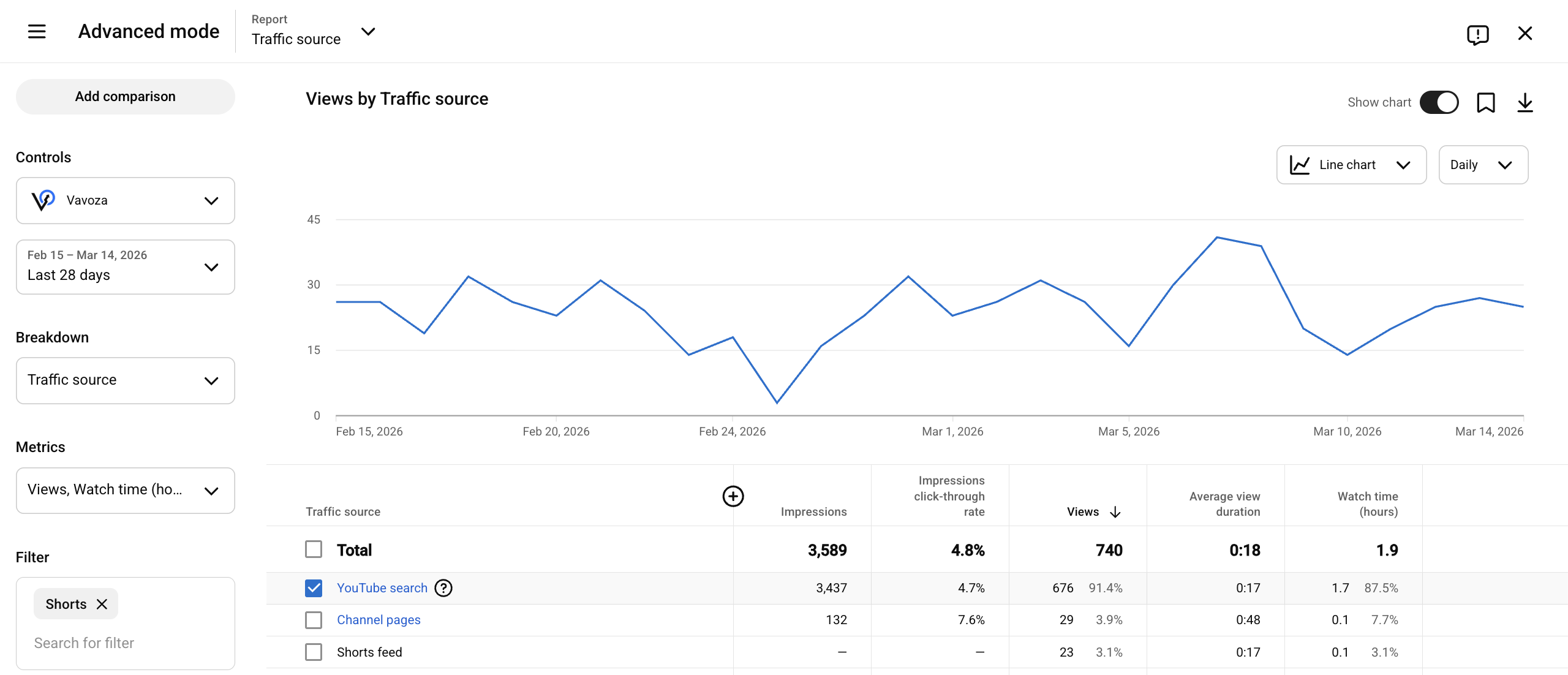
Track your Viewed vs. Swiped Away rate in YouTube Studio. If this number is low, your hook needs work. If your completion rate is low, your pacing or content structure needs tightening.
Treat analytics as a feedback loop, not just a report card.
- Pro tip: Link your Shorts to your long-form content using end screens, pinned comments, and playlists.
A viewer who starts with a Short and graduates to a 10-minute video is a much warmer lead – and this cross-format engagement also signals to YouTube that your channel provides sustained value.
Closing Remarks
YouTube Shorts are no longer a secondary content format.
They are a primary search and discovery channel with over 200 billion daily views and a dedicated search filter that puts your content directly in front of viewers who are actively looking for the solution you provide in your lead magnet and offer.
The creators who treat Shorts with the same strategic rigor as their long-form content (optimizing titles, descriptions, hashtags, hooks, and transcripts) will be the ones who build consistent audiences and leads in 2026.
The window is still wide open. Most creators are still posting without a search strategy and are clueless about YouTube Shorts SEO (even though it’s quite simple, as you may have realized after reading this article). That is your advantage.
Would you like to keep up with the latest digital marketing trends and tech news daily with unmatched speed and conciseness? Subscribe to Vavoza Insider 🗞️