

Would you like to know one of the biggest differentiators between our biggest and smallest clients’ ad campaigns?
Our most successful clients have multiple upsells and/or cross-sells on the front end of their sales funnels, which allows them to significantly outspend and outperform those that do not have additional offers after the initial offer.
In fact, sales funnels without immediate post-purchase offers almost always lose money on the front end with paid ads at any decent scale (at least in the info product space in 2024).
Sales funnels with multiple upsells and/or cross-sells generate significantly more revenue in a shorter period of time than funnels with just one front-end offer because upsells and cross-sells significantly increase the average order value and profit margin.
In paid advertising, the more you can “afford to lose” on the front end by setting higher targeting bids (aka bidding higher in ad auctions) – the more you can spend on ads, the more high-quality leads you can get, and the higher you can scale your campaigns.
Having seen this trend in all our agency’s managed campaigns, we feel compelled to inform and inspire you to take your sales game to the next level.
In this second part of our offer-building series, we share a list of unique ideas for creating upsells and cross-sells that can help you maximize your revenue.
What is an Upsell and a Cross-Sell?
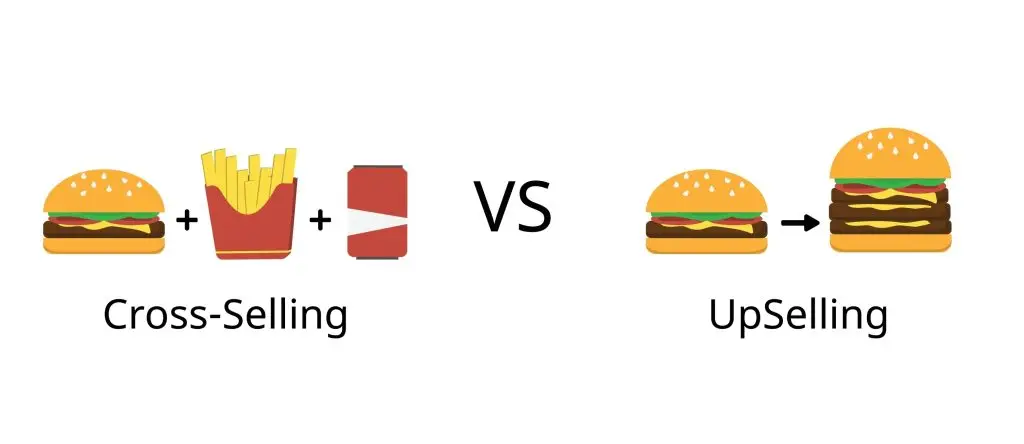
An upsell is a higher-ticket offer you sell to customers after they buy your initial offer. It can either be a higher-end version of the same product or a complementary offer that significantly enhances the product.
For example, if you sell a book about affiliate marketing, your upsell can be a course consisting of the same content as the book but in video form and with visual guidance.
A cross-sell is a complementary offer you sell to leads or customers before or after they buy your initial offer. It is a product or service that complements or is relevant to the initial offer, and it can be priced lower or higher than the initial offer.
For instance, if you sell a book about affiliate marketing, your cross-sell can be another book, a custom notebook for taking notes, or a branded pair of reading glasses.
- Do not confuse upsells and cross-sells with order bumps, which are done during the checkout process and are typically priced lower than the primary offer.
An example of an order bump would be offering an audio version of your book during the checkout process (you would have an option for people to buy the book standalone or with an audiobook included for a small extra fee). - Also, for your reference, a downsell is a lower-ticket offer you sell to customers who reject your upsell. For example, if you sell a book about affiliate marketing and try to upsell a course, but the customer rejects it, you can down-sell a crash course at half the price.
In this article, we focus on upsells and cross-sells, but consider using order bumps and downsells, too, as they all work together to maximize your revenue.
You can offer an upsell or cross-sell immediately on the front end of your sales funnel (on the initial offer’s purchase confirmation page) or later on in the customer journey. It all depends on your business model and whether or not your initial offer presents an opportunity for a complementary or higher-end offer.
Generally, the sooner you can upsell or cross-sell, the quicker you can scale your campaign.
If you haven’t yet, read the first part of this series, where we discussed value stacking – the prerequisite for crafting irresistible upsell and cross-sell offers.
Ultimately, making irresistible offers with compelling value stacks and offering multiple upsells or cross-sells (with their own value stacks) on the front end of your sales funnel can immediately skyrocket your sales and revenue.
Unique Upsell and Cross-Sell Ideas
In this section, we provide you with a list of 17+ unique ideas for crafting your upsell and cross-sell offers. Each idea below can be a standalone offer you can sell to your customers immediately after their initial purchase or later on (depending on your business model).
You can also stack multiple ideas from this section and create irresistible bundles following the same value-stacking concept shared in the first part of this two-part series.
Furthermore, you can use these ideas to create epic order bumps and downsells, too!
Our goal is to provide you with viable options, but it’s up to you to use our ideas and build great offers that make you more money. So, be creative and allow yourself to expand on our content and produce your own original ideas.
- Solution to Existing Problem: As you sell your initial product and collect customer feedback, you might recognize common problems and concerns customers experience with your product.
Generally, we recommend giving away solutions to those problems as part of your commitment to constantly improving your products and serving your customers; however, if providing an additional solution is costly or time-consuming, offer it as an upsell.
Use phrases like: “Often purchased with [your initial offer]” or let the new customers know that previous ones purchased the add-on by saying, “Customers who purchased [your initial offer] also purchased [your additional solution].” - Newest Model: If your customer buys an older version of your product, encourage them to upgrade to the latest model or version. This idea is more relevant for selling physical goods.
It would be strange to sell an older version of a digital course and immediately try to upsell a newer edition; however, it’s okay to upsell a newer version at a later time in the customer journey.
For example, if you sell a course on affiliate marketing in 2024 and then create a new course in 2025, sell it as a separate product. You wouldn’t get a 2025 model of your car at the dealership for free just because you purchased the 2024 model. Similarly, your customers are not entitled to a newer version of your digital product. - Special Promo: Do you have an ongoing sale that your new customers might want to know about? Mentioning special offers and promos on your initial offer’s post-purchase confirmation page is a great way to persuade new customers to buy another product while they are in the buying mood.
This allows you to maximize your special promo’s revenue while hooking your customers up with a great deal they might appreciate. - DFY Option: If you sell an educational program, you can upsell a complete Done-For-You service and help your customers implement the information in your program. For example, if you sell a course on how to set up an affiliate marketing website, you can offer a DFY service and set up your customer’s website for them for a fee.
If you are an affiliate marketer selling third-party offers, this can be your own first-party offer!
You would simply need to reach out to your referred buyers and offer them your service or send them to a long-form sales page where you explain what you offer, why they might want to take you up on the offer, and what it will do for them (or prevent them from doing). - DIY Option: If you sell a service, you can offer a Do-It-Yourself option and allow your clients to implement the service independently by walking them through the steps. This can be a hands-on workshop or consultation in which you explain everything they need to know to successfully “do it themselves.”
This option is attractive for people who enjoy learning and want to acquire valuable skills, and for companies that want their in-house team to implement your service.
Years ago, we learned this the hard way when one of our agency’s clients used us to set up their ad campaigns and then took over them to avoid paying our management fee. The lesson? If they want to do it themselves, you might as well offer it as a service and help them do it right (for a price). - Expedited Service: If you offer time-consuming services, offer a “rush work” option. For example, a typical turnaround time for a wedding photo editing service is eight weeks; however, clients can pay extra to get their photos edited and delivered in just one week. Our go-to graphic designer implements this model, too.
- Extended or Flexible Access: If you sell a product or service with a limited access period, you can upsell an extension and give your customers more time to use the product or service (without feeling pressured by time) or offer a non-limited access option.
For example, if you sell a live event, you can offer your buyers a flexible ticket, which allows them to attend one or more of your future events just in case they cannot make it to the one for which they have registered (or if they want to attend more than one event).
You can also sell extended access when offering a free trial. For example, if you offer a 7-day trial, give users an option to upgrade to a premium 30-day trial.
Doing so allows you to capture customers, and their small commitments increase their likelihood of staying post-trial and making larger commitments with your company. - Lifetime Upgrade: Everyone loves unlimited and unrestricted access to the things they buy. Offer Lifetime access as an upsell to customers who are on a recurring plan with your company.
Lifetime upsells are convenient for both you and the customer for the following reasons:
By upselling Lifetime access, you get more revenue upfront (which is crucial for scaling paid ads) and reduce support tickets related to cancellations, rebills, and product access issues (which can decrease customer satisfaction).
The customer, on the other hand, takes advantage of an opportunity to save money in the long run, eliminates recurring costs and potential access issues, puts themselves in a favorable position with your company, and feels at ease knowing they can enjoy your product or service continually at no additional cost or a potential increase in the subscription cost. - Premium Course, Guide, or Newsletter: If your digital products have multiple tiers and options, offer a one-time discount on access to the next level of product or service.
Also, even if your initial offer has nothing to do with information, consider cross-selling some kind of informational product related to your customers’ interests or needs (it’s an ethical cash-grab opportunity for you). - Certification Program: If you sell a class, course, or program, offer a paid exam and/or certificate of completion to students who successfully complete your program. Remember, certification is valuable and desirable when it is widely recognizable, credible, and beneficial to your students in their industry.
- Private Consultation: Are you an expert or specialist in a craft related to your customer’s needs or desires? Consider offering a private consultation as an upsell or a cross-sell. Determine how much your time is worth to you and set your consultation price accordingly.
- Recordings & Replays: If you sell a paid workshop or an in-person event, offer a recorded replay of the event. You can also convert your event recording into an on-demand course and position it as a standalone program rather than a replay of an event.
- SaaS Tools: Cross-sell relevant software, whether your own or third-party (via your referral link). For instance, one of our agency’s clients sells stock market investment courses and offers a stock analysis tool to his students.
In fact, most of our clients sell third-party software to their customers and earn affiliate commissions from them.
Here’s a different perspective: SaaS companies typically have many options, such as additional features, automation, tech support, and much more, all ready to be sold to customers.
If you are an affiliate promoting SaaS tools, you can nudge your referrals to explore additional features (if you are positioned to earn commissions on them, of course). - Relevant Extras: Cross-sell complementary products or services whenever possible. If you sell a high-end physical product, you may want to cross-sell a protection plan or relevant products that enhance and improve your customers’ experience while using the product.
For example, if you sell a computer, sell a protection plan, a mouse, a keyboard, and other computer accessories. - Customization: Who doesn’t love a tailored and personalized experience? For example, let’s say you are promoting a health app. Chances are that your target audience is looking to lose weight or build muscle.
You can offer custom workout routines that give people alternative options to basic exercises or recommend diets that accommodate those who are vegan. - Paid Community Membership: Being a part of a community with a similar mindset and where you can craft lucrative relationships is priceless. People pay for memberships to be part of the crowd who fly private and play golf, so why wouldn’t they pay to be part of a valuable community in their (and your) niche?
Read this VIP Case Study to learn more about starting a paid community. - Third-Party Vendors: Consider offering premium access to exclusive deals from your vetted and trusted vendors. This is especially relevant if you sell information or community access and work with high-end vendors.
You can have regular vendors for your entire community and offer access to premium, high-in-demand vendors for a price.
Bonus: Pricing Your Offers
Value-stacking is for improving your initial offer’s conversion rate, while upsells and cross-sells are for maximizing revenue; however, your initial and additional offers must be priced right, or your efforts will go to waste.
It’s crucial to find a good balance between the value you can stack in your offers and the price you can set.
The rule is simple: the higher the price of your offer, the more value you add to its stack.
If your offer sells too easily standalone, you are selling it for too cheap. If your offer doesn’t convert your target audience, you likely didn’t add enough value to your stack to make it irresistible.

Where should you start?
- If you know your target market, you know the typical price range for offers similar to yours – start somewhere in the low range, as it’s always easier to increase prices than lower them.
- If you don’t know the typical price range for similar offers, study your industry’s benchmarks. Opt into other successful companies’ lead magnets and go through their sales funnels – someone out there is probably already selling an offer similar to yours!
Once you know where to start with the price, the hardest part becomes finding or creating relevant things to stack on top of your primary offer to make it more valuable (and finding or creating products you can upsell or cross-sell).
Hence, the list of unique ideas provided in this two-part offer-building series.

Closing Remarks
There you have it. We explained why you should have upsells and cross-sells in your sales funnel and provided a list of unique ideas for creating additional offers.
Remember to create compelling value stacks for your upsells and cross-sells – make them irresistible, just like your initial offer.
Having irresistible initial offers, upsells, and cross-sells (and pricing them right) is key to running successful marketing campaigns at scale.
Stay tuned for more actionable marketing insights and information from Vavoza Insider Plus.