

OpenAI said on February 9, 2026, that it has begun testing ads in ChatGPT for users in the United States.
The test applies only to logged-in adult users on the Free and Go subscription tiers. Paid plans, including Plus, Pro, Business, Enterprise, and Education, will not display ads.
According to OpenAI, ads will be clearly labeled as sponsored and visually separated from ChatGPT’s responses. The company said ads will not influence or alter the answers ChatGPT provides.
Conversations, chat history, and personal details will remain private and inaccessible to advertisers.
During the test, ads are selected based on the topic of a user’s conversation, past chats, and previous ad interactions.
Advertisers receive only aggregated performance data, such as views and clicks, not individual user information.
OpenAI said ads will not appear for users under 18 or alongside sensitive or regulated topics, including health, mental health, and politics.
Users will have controls to dismiss ads, manage ad personalization, delete ad data, and view ad history. The company said the test is designed to gather feedback before any broader rollout.
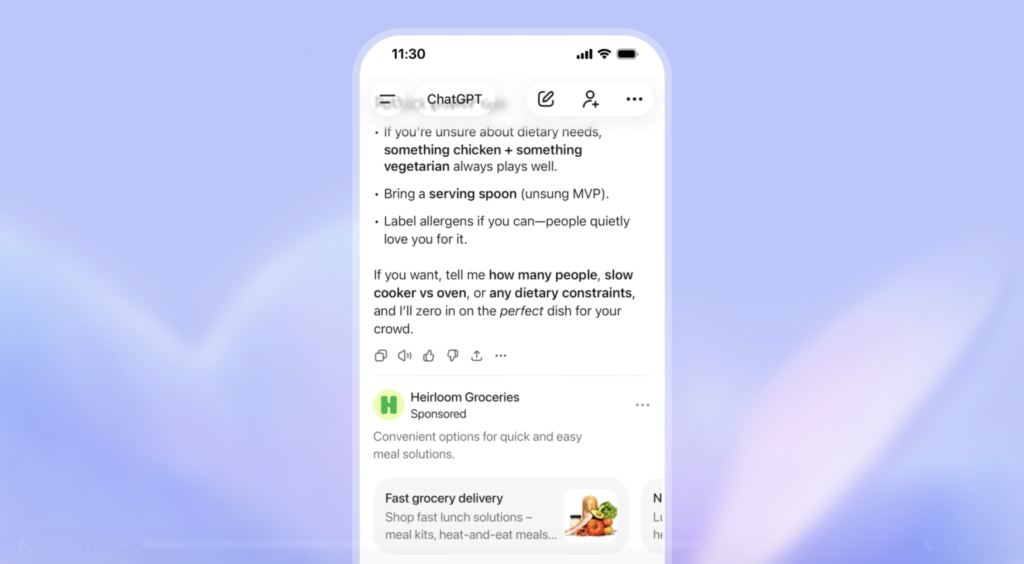
Image Credit: OpenAI
Why This Matters Today
ChatGPT has become a widely used tool for learning, work, and personal decision-making, creating pressure to support growing infrastructure costs while maintaining free access.
Advertising offers OpenAI a new revenue stream without immediately raising prices for entry-level users.
The move marked a shift in how conversational AI products are monetized. Unlike traditional search or social platforms, ChatGPT operates in a context where trust and neutrality are critical.
OpenAI’s emphasis on answer independence and privacy signaled awareness of potential backlash if ads were perceived to influence outputs.
For advertisers, ChatGPT presents a new environment where users are often exploring ideas or evaluating options in real time.
That context could make ads more relevant, but also raises concerns about over-targeting and transparency.
The test also highlighted competitive dynamics in AI. As rivals expand paid offerings, OpenAI is experimenting with hybrid models that blend free access with advertising.
How users respond will shape whether ads become a permanent feature and how aggressively OpenAI expands formats, targeting, and buying options over time.
Our Key Takeaways:
OpenAI began a limited ad test inside ChatGPT focused on learning and feedback. The company stressed that ads will not change answers or expose conversations. User control and privacy were central to the design.
The outcome will influence how AI chat products balance access, trust, and monetization.
- OpenAI started testing ads in ChatGPT for U.S. users on Free and Go tiers.
- Ads are labeled, separated from answers, and do not affect ChatGPT’s responses.
- User feedback will determine whether and how the ad program expands.
You may also want to check out some of our other tech news updates.
Wanna know what’s trending online every day? Subscribe to Vavoza Insider to access the latest business and marketing insights, news, and trends daily with unmatched speed and conciseness. 🗞️