


As an agency, we manage millions of dollars of ad spend for companies and individuals that sell informational products, such as educational programs, courses, and masterminds.
Most of our clients’ go-to tactic for selling info products is free webinars, and they are experts at delivering strong presentations and effectively converting webinar attendees into buyers.
In fact, about 80% of the campaigns we manage at the Vavoza agency utilize webinar funnels, and there is a good reason for that: they work!
In the past few years, we have helped our clients generate tens of millions of dollars in sales by driving targeted leads to their free and paid webinars – both live and completely automated.
In this exclusive Vavoza Insider Plus issue, we dive deep into how you can create your own high-converting webinar and share everything we would tell you if you were our agency’s client, for you to have a successful webinar funnel.
We also provide additional insight on this topic from experts who have presented thousands of webinars and generated millions of dollars from webinars alone – courtesy of our agency’s clients.
Webinar Campaign Essentials
With our invaluable experience as an agency, we have a wealth of powerful insights and ideas to share with you about webinar funnels. In this section, we share the prerequisites for crafting, running, and optimizing effective webinar campaigns.
Why Do Webinars Work So Well?
A webinar essentially serves as the middle and bottom of the marketing funnel. It allows you to connect and build rapport with your cold leads and “funnel” them down your sales funnel in a relatively short period of time.
When selling mid-to-high-ticket info products, you must connect with and build trust with your leads to convert them. Without trust, you will likely not convert anyone. A proper webinar allows you to do just that (and much more).
Once you understand what goes into crafting an effective webinar, you will gain more clarity on how to build rapport and trust with your leads via webinars (more on this in section 3).
Performance Metrics & Benchmarks
Let’s define a few essential metrics we commonly use to analyze the performance of webinar campaigns. We will also share performance benchmarks for our clients’ webinar funnels with leads generated from YouTube video ads.
- Registration Rate = The number of people who register for the webinar divided by the number of registration page visitors. The webinar registration rate is typically around 10-15%, but it can range from as low as 5% to as high as 40%, depending on the ad and targeting type.
A typical cost-per-registration (CPR) for low-scale (under $2,000/day ad spend) is $10-15, assuming you run YouTube video ads targeting high-intent audiences in top-tier English-speaking countries, use the Target CPA bidding strategy, and do not utilize audience expansion features. - Show-Up Rate = The number of people who attend the webinar divided by the total number of registrants. The webinar show-up rate is typically around 25-30%, but it can get as high as 50% and even higher, especially for Just-In-Time (JIT) and paid-entry webinars.
- Retention Rate = The number of people who stay in the webinar room until the offer is shown, divided by the total number of attendees. Typically, about 50% of people stay on the webinar until the pitch.
- Sales Conversion Rate From Total Attendance = The number of people who buy the offer presented in the webinar divided by the total number of webinar attendees. A typical conversion rate from all webinar attendees is 5-10%.
- Sales Conversion Rate At The Pitch = The number of people who buy the offer presented in the webinar divided by the number of people who stay in the webinar room until the offer is shown. A typical conversion rate from people who see the offer in the webinar is 10-20%.
Just-In-Time (JIT) webinars tend to have a higher registration and show-up rate, but a lower retention and sales conversion rate, compared to live webinars.
A major factor contributing to a higher sales conversion rate appears to be the engagement between the presenter and webinar attendees who comment in the chat room – this is why Live webinars tend to outperform pre-recorded ones.
However, a pre-recorded webinar converts well when the presenter engages the audience, addresses all frequently asked questions, overcomes any necessary objections, and makes it easy to purchase the presented offer.
Continually analyzing these metrics allows you to optimize your webinar campaign and improve (or maintain) optimal performance. Of course, there are many other variables to running a successful webinar, all of which we will cover in the following sections.
Troubleshooting Your Webinar Campaign
Here is a breakdown of how to troubleshoot your webinar campaign and what you may want to focus on to improve performance:
- Low Registration Rate: If the webinar registration rate is low and the cost-per-registration (CPR) is too high at a low scale (under $2,000/day ad spend), you likely need to optimize the registration page to improve the conversion rate. Targeting the wrong audience, using the incorrect ad type, or employing the wrong bidding strategy can also lead to a low registration rate and a high CPR.
- Low Show-Up Rate: If the registration rate is adequate but the show-up rate is low, you likely need to optimize the follow-up approach or attract a higher-quality audience to the funnel. A high registration rate does not necessarily mean a high-quality audience is registering for the webinar.
- Low Retention Rate: If the show-up rate is good but the retention rate is low, you likely need to optimize the webinar presentation. There might also be a disconnect between what registrants expect to hear in the webinar and what is actually presented. Ensure the targeting, ad content, registration page, and webinar presentation are congruent – always address the same audience on the relevant subject.
- Low Sales Conversion Rate: If the webinar retention rate is good but the sales conversion rate is low, you likely need to optimize the pitch or the offer. To craft high-converting offers, study our two-part Offer-Building Series: The Ultimate Guide To Creating Irresistible Offers.
Alternative Metrics
The metrics mentioned above can help you analyze your campaign’s performance and give you a good indicator of which part of your funnel needs optimization; however, we encourage you to take your webinar optimization a step further.
To ensure optimal performance, we recommend considering sentiment.
In other words, pay attention to how your webinar attendees interact with your presentation: Do they express appreciation and gratitude or irritation and resentment in the webinar chat room?
If you deliver exactly what you promise on your webinar registration page, you should see positive engagement in the chat room.
On the contrary, if you overpromise on the registration page and underdeliver in the webinar, or if you treat your webinar like a pitch-fest rather than a value-focused event, your engagement will likely be negative.
Here’s why sentiment matters:
Yes, your webinar can still produce a positive return on ad spend (ROAS) and return on investment (ROI) despite negative sentiment; however, word-of-mouth matters.
Do you really want thousands of people to speak negatively of you on the internet because of a bad experience with your webinar?
Also, just because someone does not buy your offer doesn’t mean they are forever lost to your brand; they can still become your followers and future customers.
- Recently, we had an onboarding Zoom call with a new client at our agency, and he mentioned one of our other clients (Sid). Our new client is not Sid’s customer, yet he knows of him and speaks highly of him.
Why? He attended Sid’s webinar in the past, where he received great value for free and, as a result, became Sid’s follower and advocate.
Sentiment matters! Focus on creating a positive experience for all your webinar attendees, not just those who are likely to make a purchase. Remember, building your brand is often about more than getting the sale.
Webinar Nuts and Bolts
In this section, we share things you must consider before scripting, recording, or going Live with your webinar.
Platform
The webinar platform you use to host your webinar matters. We’ve managed countless webinar campaigns on various platforms, and the two that stand out the most in terms of performance are Zoom and WebinarFuel.
Both offer an in-app experience, which tends to have the highest retention and sales conversion rate.
Audience
Before scripting or crafting your webinar presentation and pitch, you must know precisely who your target audience is. Your presentation must align with the overall customer experience throughout your marketing and sales funnel.
Objective
What are you trying to achieve by having people register for your webinar? Craft your webinar flow in accordance with the outcome you hope to achieve.
Prepare all the necessary elements, such as customer testimonials, responses to FAQs and common objections, and the call-to-action (CTA) link where people can buy your offer or fill out an application form to get on a call with one of your closers.
Style & Format
Choose the format of your webinar, which is likely determined by your objective and how you believe you can best achieve the desired outcome. Here are some options to choose from:
- Educational
- Q&A
- Product Demo
- Panel Webinar
- Exclusive Interview
- Case Study
- Self / Brand Introduction
Also, decide whether you want to do a Live webinar or a pre-recorded one, scheduled or Just-In-Time, presented via slideshow or whiteboard (or neither), and so forth.
Backup Plan
Believe it or not, not every event you put on will go smoothly. Life happens without regard to your event. So, have a backup plan in place just in case.
For example, be ready to email your registrants with a new event date and time. Consider practicing before going Live; run a test event.
Here are some of the things we’ve encountered with Live webinars (brace yourself, you are about to get shocked):
- WiFi disconnected
- Webinar software crashed
- Severe weather sirens went off
- Fire alarms and sprinklers going off
- Family emergency
- Cyber attack during the event
- CTA link not working
- Panel guests late or unable to join
- Slideshow not working
- Dead microphone battery
- Dead laptop battery
- Host stuck in traffic and unable to start the event
- Wrong webinar link sent to registrants
- Kids running into the room behind the host
- Butt-naked man forgot to turn his camera off during a group meeting (this really happened, not kidding…).
- Etc.
Post-Event Action
We recommend that our agency’s clients have a long-form sales page, where they can send nurture and follow-up messages to warm leads (such as webinar attendees who haven’t purchased the offer) to convert them.
Your long-form sales page can include the following elements:
- An action-oriented headline
- A subheadline that supports or completes the headline
- A video overviewing and pitching the offer
- Visual elements, such as infographics showing your value stack
- A few bullet points highlighting key features, benefits, or outcomes your offer promises to deliver
- Customer reviews and testimonials
- CTA statements and buttons leading to the checkout page
Be sure to send your long-form sales page or checkout page link to all webinar attendees who saw the offer during the webinar, after the event. This ensures they do not lose the CTA link and are able to join, whether it is immediately or in the following days (with the help of a few follow-ups, of course).
Also, re-engage non-attendees by inviting them to your next event or sending them a replay. After sending them a few nurturing messages, you can direct them to your long-form sales page to buy your offer.
Do not waste your leads by disregarding them if they don’t show up to your event or immediately buy your offer – keep nurturing them, and many of them will eventually convert into buyers.
How To Structure A High-Converting Webinar
In this section, we share how to structure the content of your webinar for optimal performance. For this part, we asked a couple of our agency’s clients, who have run thousands of successful webinars, to share what they believe are the most important elements of a high-performing webinar presentation.
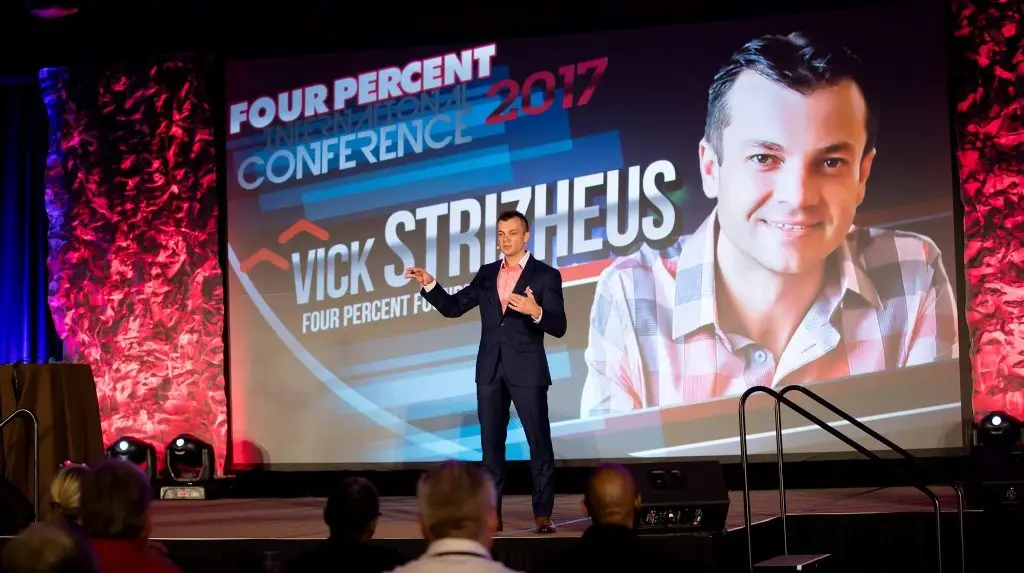
Vick Strizheus’ Insight:
Vick Strizheus is an expert at presenting and selling via Live and pre-recorded webinars. His style is raw and unpolished (and it works).
We asked Vick, “What would you say are the top elements of presenting and selling in a webinar from your experience?” and here was his response:
- Believe in what you sell;
- Have a storyline – how this came to be and why you are selling it (gotta be more than just selling a product);
- Be cool and personable – come across as if they already know you;
- Ask for the sale with the full expectation that everybody wants and should buy your thing;
- Give an offer they can’t find elsewhere that promises to solve their problem the easy way.
– Vick Strizheus

Siddharth Rajsekar’s Insight:
We asked Siddharth Rajsekar to share some of his thoughts based on his vast experience in testing and running hundreds of successful webinars in the digital coaching space, and here is what he had to say:
–––
Over the last six years, I’ve personally conducted over 600 sales webinars (free webinars in 90-minute to 2-hour formats). I’ve also done workshops, boot camps, and multiple other sessions. Besides sales webinars, I’ve easily done more than 400 community calls and some kind of daily training.
I’m going to share some insights into generating sales through webinars, the different sales models that you can apply in a webinar, and the different components that have to be present in a sales webinar for you to generate sales.
1) What Happens Before The Webinar
First, let’s look at the inner game, and then we’ll go to the outer game.
Usually, when it comes to sales, people think it is more about tactical knowledge (the offer or its price, or whatever), which is important, but it’s also how you pre-frame your audience before they come for the webinar that matters.
Meaning: what you say in the ads, your energy in the ads, the emotional angle you use in the ads to cater to the right target market, and, of course, the targeting of the ads and whether or not they are reaching the right people.
Converting more people during a webinar is not just about the webinar; it’s about what happens before the webinar.
I’ve observed that usually, it’s not the main moment that influences the purchase. There are many moments before the buying moment that have actually influenced the purchase – the emails they have read, the videos they might have watched, and the podcasts they might have heard.
When I look at my webinar conversions, the people who come in and buy are ready to buy right from the beginning because I nurtured them in multiple touchpoints once they entered my lead system.
I give the analogy of a funnel and pouring honey into a funnel. If you pour water into a funnel, the water will instantly come out from the other side due to the gravitational force, but when you pour honey into a funnel, it takes time, and that’s how I look at lead generation.
So, even though somebody might have been my lead yesterday, I’m not looking at that lead to buy my product tomorrow – I’m looking at that lead to buy my product maybe in the next three to six months.
So, the lead flow has to be continuous for your customer flow to be continuous, and that’s the first concept I want to share – it’s what happens before the webinar.
2) Your Energy, Vibration, and Intention
When I look at the coaching and training industry today, we have so many people who are trainers and coaches, and their entire process is based on data or some kind of tactical knowledge, but the market has matured so much in the last few years that people are able to see through any kind of bullshit.
They’re able to see if someone is there for themselves or if they are in it for the community.
That is why when I’m selling in my webinars, I’m selling a community; I’m not selling just a tactical thing or some kind of data-based knowledge.
When you sell something based on knowledge and information, people will go to other places where they can find better knowledge and information, but when you’re able to sell a journey into a process where they are going to grow as people, and you provide an environment for them to grow, you’ll have more sustainable sales and your customers will be with you for life.
But for you to be able to sell this way, you have to look at where you are coming from.
In my case, I learned from mentors who believe in communities, value systems, a code of honor, ethics, and morals, and not having a transactional mindset but more of a long-term mindset – and the background of coaching that I have come from shows through in my content.
In fact, I believe that if you look at any coach or marketer out there, if you are smart enough, you’ll be able to know what their influences are; whether they’re coming from a transactional influence or a long-term relationship-building kind of an influence, and usually that comes based on who they’re learning from.
So, the second most important part is that if you want to convert and sell through webinars, you need to examine your own intentions, energy, vibration, inner game, and what you are working on.
3) Tactical Knowledge
I’ve used different webinar formats, and I’m going to share one that is working really well for me. Even through my automated webinars, I’m able to generate 14-20% conversions in some webinars using this format.
Again, it depends on the audience, but it’s a really high-converting, high-energy webinar. It’s just 90 minutes long, and I wrap it up within two hours.
Here are the nuts and bolts of the actual flow of the webinar:
- Introduction: The first component of the webinar is the intro. People are usually skeptical in those first few seconds, and they want to know, “What’s in it for me?” So, you need to straight away share what it is you’re going to be teaching, what’s in it for them, and some of your credibility pointers in terms of how much experience you have. If you don’t have any experience, you can talk about how many hours of research and effort you’ve put into your topic.
Close your intro piece with a mission statement – the reason why you are even doing the webinar. People need to understand your reason why.
My reason why has been the same from day one: I want to redefine our broken education system by creating a new breed of teachers and leaders so that together, we can fix our broken education system and bring about change in society by creating more teachers and leaders. My top three values are freedom, family, and service to the community.
I like to do value matching right at the beginning of the webinar, along with my mission.
When I strongly present my mission and values to my audience, I tell people, “If you’re not resonating with my value system, you can go to other places and learn.” This is one way I “unsell” to the audience and tell them to leave the webinar if they’re not resonating with my value system, and usually, the people who stick until the end are the ones who resonate with my value system, and they end up buying. - Case Studies: Then, I go into the second part of the webinar. I tell people, “I don’t want to waste your time, so I’m going to go straight to the proof of concept,” and I share 3-5 case studies of people who have followed my system and gotten results.
I keep the case studies really short, to the point, and fast. I don’t play any “testimonial” videos – they’re case studies; I show the before-and-after of people who have followed my system and got results. - Problems: The third piece of my webinar is the problems: What are the top 5, 6, or 10 problems that trainers and coaches face? The audience will be able to relate to that because you show the proof of concept and then show them the mirror by saying, “Hey, if you’re facing this, I have a solution for it.”
- Journey: Once I show the top problems, I shift gears into my journey and how I overcame the problem. This is where I go deeper into my story. Normally, people start their story at the beginning of the webinar, but I prefer sharing my story and my personal journey after I’ve given some kind of valuable content through case studies and the problems that are there.
Through my journey, I also share the three principles that helped me overcome the problems and achieve results in whatever topic that I’m teaching. - Three Secrets: Once I cover the journey, I go into the three secrets or my actual content – whatever I’m going to teach. I spend maybe 15 minutes on each of my three secrets. So, if I’m going to be talking about how to launch a coaching business, I talk about a) how to find your niche, b) how to design digital products, and c) how to get autopilot sales.
I have a three-step process (or a three-secret process), and I do it really fast. I give examples and make it very engaging.
So, I do 45 minutes of intro until the point of my journey and another 45 minutes of my actual content, which brings me to around the 90-minute mark when I actually start the sales pitch. - Sales Pitch: Once I cover the content, I normally “unsell” again. I tell people, “Now that I’ve shared everything with you, how many of you want to continue this journey with me? If you’re interested, you can stay in the webinar, or you can leave.” So, I’m always asking people to leave the webinar if they’re not interested in whatever I’m teaching.
This way, I’m able to keep the people who are interested; I’m able to get higher conversions and also the best customers. My refund rate is less than 0.5% because of this approach of “unselling” right from the beginning of the webinar. I don’t hype things up just because I want the sale.
After I complete my content, I lead them into the sales pitch, but I don’t sell my product as a product; I sell the journey.
I tell them, “When you come into my community, I’m expecting you to be with me for the next 1-3 years. I want to help you step-by-step, not only to build your skills but also to become a master of your craft. And becoming a master of your craft is not going to happen in one weekend; it’s not going to happen in one or two months – it’s a continuous process. And I want to welcome you to my community.”
So, I sell the journey and access to the community. Then, I do the regular process of detailing the courses I offer, the coaching I provide, and the community we have, and I build up the value of the offer.
Then, I break down the value and give a special 15-minute offer. When they complete the transaction, they can get access immediately and start learning the same day.
Once I’ve completed the 15-minute timer, I continue answering questions for about 5-10 minutes, give an orientation of what people should do next once they come into the community, and then end the session.
All of my webinars right now are automated, and it’s live-like automated, meaning I don’t use any time or date; I call out people’s names, but I don’t mention any day or time.
So, even when I’m traveling or doing other things, my team just plays the webinar, and we’re able to get some amazing conversions because of this sequence and the order of content that we have generated.
I hope you have been able to get the essence of what it takes to convert through webinars.
It is a combination of the way you pre-frame your audience, your own intentions and vibration as a coach, trainer, teacher, and marketer, and also the way that you structure your content that leads them to the sale where you’re not selling the product, you’re selling the journey (but more importantly, where you’re “unselling” and asking people not to buy your product if they’re not interested).
That’s the game.
– Siddharth Rajsekar
Vavoza’s Insight:
From our experience, there is no “one right way” to structure an effective webinar. We’ve analyzed countless of our clients’ and others’ high-performing webinars, and here is what we concluded:
- It’s not as much about what you say or how you say it – it’s more about giving your audience exactly what they expect and more. Keep your content relevant and overdeliver value.
Remember, your webinar serves as the middle and bottom of your marketing funnel. The objective is to build trust and rapport with your audience (by providing them with valuable content) and then convert them into buyers. - You must present yourself as an expert or partner with an expert and do a joint event, such as a panel webinar or exclusive interview. You must “command the webinar room” with authority (even if you do it playfully) to put the audience in an action-taking state when you call for it. The best way to ensure a confident performance is to know your topic – become an expert.
- Most of the top-performing webinars we have analyzed are approximately 90 minutes long, but we have also seen webinars that are over 3 hours long convert well. We recommend adding value to your audience for at least 60 minutes and pitching your offer for at least 15 minutes.
Show testimonials, answer FAQs, and overcome objections while delivering the pitch. Put a timer on your screen for when the webinar will end (and when the offer will expire) to create a sense of urgency and FOMO. - There appears to be a correlation between overly hypey presentations and the refund rate. Hypey webinars tend to have higher sales conversion rates but also higher refund rates; however, it all depends on whether your product or service delivers on what was promised in the offer. You can’t go wrong with underpromising and overdelivering.

Closing Remarks
The content we shared in this article is precisely what we discuss with our clients who sell info products through webinars in our private meetings and consultations.
The truth is, although we provided you with all the webinar essentials and guided you through the webinar planning process, the success of your webinar ultimately depends on you, as you are the one presenting to, connecting with, serving, and converting your leads into buyers.
Honestly, you probably won’t be great at presenting webinars on your first or second try – it’s a skill that requires practice and time to master.
Fortunately, anyone can learn this valuable skill, regardless of whether you are an outgoing and bubbly extrovert or a shy and reserved introvert.
Just like with any useful skill, practice makes perfect. So, if selling through webinars is your thing, review this article as many times as necessary, and start mastering your craft today.
– Team Vavoza